
GDM Recognition
TL;DR
FTEs from across GDM UK wanting to honour DeepMind’s original mission “to build AI responsibly to benefit humanity” are currently in negotiations with Google to legally recognise our trade union.
Our demands focus on AI safety, unethical military contracts, and guarantees over AI-led automation. Despite Google’s claims to the contrary, there is considerable historical precedent to negotiate over these areas (see What Can We Negotiate Over section below). The strength of our negotiating position comes from the size of our membership, so the more people who join the better we can do.
Our demands are shaped by our members through democratic processes (one member, one vote). Surveys can also be run more broadly across all employees: for example, now we are running a survey to gauge concerns about AI automation to inform demands on this subject.
Who are we?
We are FTEs from across all units, functions and levels in GDM UK, wanting to honour DeepMind’s original mission “to build AI responsibly to benefit humanity”. Priorities and demands are decided by employees like you through a democratic process.
We are getting support for legal and negotiation expertise from our union’s national office, but everything else is done by GDMers for GDMers. We are investing a lot of personal time and energy into this effort because we deeply care about DeepMind’s original mission.
What happened?
On May the 4th, GDM UTAW and Unite the Union members at Google Deepmind asked for voluntary recognition.
Google declined the request but have agreed to meet via the ACAS conciliation service. This means we are now entering negotiations with Google. If no agreement can be reached over voluntary recognition, we can apply for statutory recognition.
This process ends with a recognition agreement and a collective bargaining agreement, which are formal documents setting out who is covered by collective bargaining (the bargaining unit), what issues can be negotiated, how bargaining meetings work, what company resources, facilities and time off our elected reps are entitled to, and how disputes are resolved if the two sides cannot agree.
These agreements are not set in stone and typically evolve over time by expanding and updating through renegotiation.
GDM union members want to include in the agreement demands over unethical military contracts, AI Safety / Principles, and job automation. You can read the full list of demands on our campaign website. The section ‘How does it work’ explains in more detail the recognition process and how demands are shaped and discussed.
What can we negotiate over?
The message from Google’s leadership is that we can only negotiate pay, holiday and hours. This is only the minimum scope guaranteed by law. The extent to which we can broaden that scope to military contracts, enshrining AI principles and guarantees around AI-led redundancies depends on our collective bargaining negotiations. There is considerable historical precedent for this:
- The University and College Union (UCU) successfully pressured an £80,000,000 divestment from Israeli bonds and other assets in 2024 following concerns over international law violations.
- Telecoms workers in Britain took action via the Union of Post Office Workers (now the CWU, our parent union) to stop connecting all telephone calls between the United Kingdom and apartheid-era South Africa.
- In January 2026 the UK actors union Equity negotiated a contract with Pact (the trade body representing the majority of UK film and TV production) legally enshrining contractual protections over training AI replicas of actors.
- Following the military coup in Chile, aerospace workers at Rolls-Royce’s Scotland factories voted to stop servicing or repairing jet engines used by General Pinochet’s military dictatorship.
- The International Longshoremen’s Association (ILA) used a 2024 port strike to completely ban automated cranes and driverless vehicles to protect workers from AI-led redundancies until 2030.
- Video game voice actors and performers with SAG-AFTRA went on strike at major gaming studios in 2024 to ensure studios cannot replicate human voices or likenesses without consent and compensation.
Because the strength of our negotiating position comes from the size of our membership, we need everyone from across GDM to shape the union. The historic under-unionisation of the tech sector means that the vast majority of even our most active members had not been in a union before last year, so reach out to your union colleagues if you have any questions — we probably had the same questions very recently!
Useful Links
- AI Automation at GDM Survey
- Response to Si’s email
- UTAW Google campaign - especially the How Does It Work and FAQ tabs
- Sky News report on our unionising
FAQs
What does it mean for union members to have statuary recognition?
This gives GDM employees a legal framework to force negotiations on topics that we care about if Google refuses to recognise us voluntarily. By securing recognition, we gain formal rights to collective bargaining, disclosure of internal company information, and mandatory negotiation and consultation on major workplace changes.
For statutory recognition to happen there is a minimum membership threshold (10% of the bargaining unit, which we have passed) and all employees in the unit are called to vote (ballot). This means that even if you are not a member of our unions, or you don’t want to join, you can still vote. Your vote will be fully anonymous. A majority vote in favour is sufficient for recognition, there is no minimum turnout threshold.
How can we extend the collective agreement beyond pay/hours/holidays?
There is no restriction of topics that we can discuss in collective bargaining. This can include business practices, company priorities and governance process. Pay, hours and holidays is the minimum legal scope, but this isn’t the focus of our campaign and we intend to open the negotiations beyond pay, hours and holidays. To do so, we need to pressure Google to extend the collective bargaining agreement using our industrial leverage. Unions can use ‘actions short of a strike’, campaigns and ultimately, as a last resort, strikes if the employer refuses to expand the scope. The stronger the union, the more effective the pressure. Most often, a credible threat is all it takes.
It will take time, but remember that opening negotiations by getting recognition is just the first step, and then we can work on extending the agreement!
I don’t want to be affected by decisions made by union members, what can I do?
Decisions that affect you are already made by a much smaller pool of management executives, with no visibility or meaningful input from you: you were not consulted on the removal of the autonomous weapons or mass surveillance pledges from the AI Principles, nor on the safety risks from contracts that carry significant human rights implications.
It will never be possible to make decisions everyone is happy with all of the time, but collective decision-making will add more democracy, not remove it. We will have a way to demand changes, and the company will have to consult us before making major decisions affecting the workplace.
Although voting on demands is restricted to union members, surveys can be run among all employees to better understand people’s needs. For example, we are now running a survey on job automation to inform our demands on the topic. And if you have any concern you can always reach out to your union colleagues.
With all this said, you will never be forced to engage in these discussions or join any union.
Have you tried going through the UK Googler Forums?
We have tried to open the dialogue through the UK Googler Forums, but leadership declined to discuss ethical matters through this forum. Other routes such as petitions with broad support, letters or questions at townhalls have also been tried and ignored.
What is ‘Union Busting’?
Let’s ask Gemini!
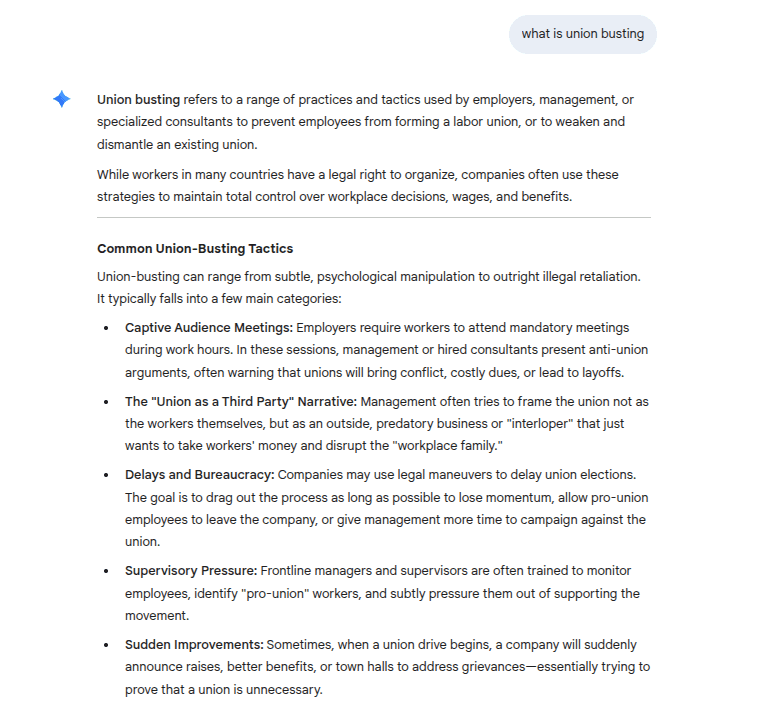
The best way to counteract union busting is:
- Resist intimidation by knowing your rights and UK law. Union activity is well protected in the UK. We have a section in the FAQs on our website.
- Make sure to diversify the source of information and listen to different narratives around union-related topics to build your own informed opinion. Assume leadership have a bias in their comms about unions.
- Talk with your colleagues, learn about their experience and their motivations directly from them!
Why doesn’t Google want us to form a union?
Together we can formally act as an employee-side counterweight to management’s ability to exercise unchecked authority. Management’s self-interest is to prevent us from having this kind of power.